Rechercher dans ce blog

Monday, June 29, 2020

Four tools that help researchers working in collaborations to see the big picture - Nature.com

suaralifestyle.blogspot.com

In January 2019, NASA announced that its Transiting Exoplanet Survey Satellite had discovered a planet about three times the diameter of Earth. The planet, orbiting a dwarf star 16 parsecs (53 light years) away, was found using sophisticated equipment including the satellite itself and the Magellan II telescope at Las Campanas Observatory in Chile. But its discovery also relied on a more prosaic tool, says astronomer Johanna Teske: the project-management software Trello.

The five-university consortium that oversees the telescope uses Trello to track and manage the queue of astronomical targets that different teams want to observe, says Teske, who works at Carnegie Observatories in Pasadena, California. “The way that Trello organizes information seemed very much in line with the type of information we wanted to capture,” she says, and it’s worked well.

Popular project-management tools for research teams include Trello and Jira, both from the company Atlassian in Sydney, Australia, as well as Asana and GitHub project boards, both in San Francisco, California. These tools are more than simple to-do lists. They help teams to see the broad view of a project, allowing users to create and complete tasks, meet deadlines, capture detail-rich notes and provide templates for common protocols. The tagging functions of these tools allow managers to assign tasks to team members. If used well, they can make teams more efficient and minimize frustrations such as forgotten tasks and duplicated work.

In short, project-management tools and the managers who use them “connect the details with the high-level goals”, says Tracy Teal. As the executive director of Dryad, a non-profit repository for open data in Durham, North Carolina, she uses several such tools.

Management experience

At the Broad Institute of Harvard and MIT in Cambridge, Massachusetts, computational biologist Beth Cimini manages a small consultancy group within a larger team run by cell biologist Anne Carpenter, which focuses on automated image analysis. Carpenter’s group uses project-management tools to handle tasks ranging from keeping track of the team’s overall direction to experimental design, Cimini says — the latter thanks to a Trello template that automatically pre-populates notes with standard operating procedures so that laboratory members don’t forget key steps. “It’s definitely reduced the amount of time we spend reproducing what someone else has already done,” Cimini explains. Her own team uses Trello and GitHub project boards to juggle their clients’ needs. “It would be hard for each person in our group to have ten different projects a year” without them, she says.

Project-management tools tend to have a common visual style, called a Kanban board. This is divided into columns, called lists, with multiple cards pinned to them to represent different projects, protocols or topics. Users can make multiple lists (for example, ‘To do’, ‘In progress’ and ‘Done’), create individual to-do items (either in the app or by sending an e-mail to a dedicated account), tag teammates to assign tasks, and drag the cards from board to board as their status changes. Many tools can also display a timeline or calendar view, and provide apps for use on mobile devices.

But there are differences, and most tools offer both free and paid tiers, with different incentives for paid accounts. “It’s worth exploring the different tools a bit and finding the right ones for you,” recommends José Sánchez-Gallego, an astronomer at the University of Washington in Seattle. “Personally, I prefer tools that do one thing but do it well, rather than tools that allow you to do many things but become more cumbersome.”

Sánchez-Gallego actually uses multiple tools for project management in his day-to-day work. These include ZenHub for managing GitHub issues for the Sloan Digital Sky Survey telescope in New Mexico; Jira for overarching project management, hardware issues and input from users; and OmniPlan for creating timelines and tracking time. “I like to look for simplicity and good overall design,” Sánchez-Gallego says. “I also prefer apps that can work offline over web apps that only work when connected to the Internet. And I prefer tools that don’t require me to share too much personal information.”

With any project-management tool, the most difficult part is establishing a routine for using it, says Cimini. “It’s easier to enforce doing that when it’s collaborative,” she says. “My collaborative Trello boards stay more up to date sometimes than my personal one.”

Appoint a manager to run the tool at a team level, Teal advises. The Data Curation Network, of which Dryad is a partner, has a project manager who goes through the team’s Jira to-do items and pings a message to people if tasks aren’t done, Teal notes. “The social connection between the tool and the team is a person who consistently makes that connection,” she says.

Whichever project-management tool you use, ease your team into it to avoid overwhelming them, says Rafael Carazo Salas, who began using Trello after coronavirus-related shutdowns to aid communication and assign tasks in his stem-cell differentiation lab at the University of Bristol, UK. And don’t feel you must restrict yourself to tasks, he adds. Salas has started using Trello to share literature with his team, tagging members on articles that are especially relevant to them. The literature keeps Trello interesting, and the tags alert people until checking the tool becomes a habit, he says. “Make it reach out to them,” says Salas, “instead of making it a static board that they need to actively go and check.”

Project toolbox

For the Magellan II telescope collaboration, Teske says, it is Trello’s nested structure that allows the team to manage its users’ needs. There’s a board for each of the five institutions, which is visible only to that institution, and a separate board for the administrative team that is filled with astronomical targets for each slot of observing time. When a scientist wants telescope time, they create a card on their institution’s board, which the administration team then moves to the observation board. Cards can include notes, PDFs and data files, and any other useful information. An archive board serves as a record of everything that has been done. “I think people find it intuitive,” Teske says.

But small teams can also benefit from such tools. For Cimini’s five-member team, Trello’s integration with Tick, its time-tracking and billing software, has proved particularly useful to automatically track the amount of time they’ve spent working on projects that are billed separately, or to allocate how much time to spend on specific tasks. (Asana also integrates with Tick.)

Pre-formatted boards called templates are also useful, because they provide a starting place for common tasks. In Cimini’s group, every time a team member kicks off one of their standard experiments, they use a template so they can be sure of completing every step in the protocol, she says. Cimini has also created a template for travel, which includes standard tasks such as booking flights and hotels, and preparing presentations. This feature is particularly useful, she says, because the travel card stays on her Trello board until she remembers to file for reimbursements.

In her previous position at The Carpentries in Oakland, California, an organization that teaches coding and data workshops, Teal and her co-workers used Asana templates to ensure that they would remember to add essential components such as context, recurring tasks and milestones to every project. And they had a standard template to ensure that they completed all the tasks in the right order to be able to launch their workshops.

Project-management tools typically support plug-ins to enhance functionality. Trello, Jira and Asana can all integrate with the code-sharing site GitHub, for instance. But for developers and scientists who already spend a lot of time on the site, GitHub project boards are particularly appealing, say Teal and Cimini, whose teams both use this tool.

GitHub is a collaborative platform for people who develop software. Project boards organize GitHub’s social elements — issue trackers, comments and code updates called pull requests — into a Kanban-like board. “It’s this quick graphical way to understand how behind I am,” says Clair Sullivan, a machine-learning engineer at GitHub, who is based in Breckenridge, Colorado. Whenever a programmer flags an issue (such as a bug report or a request for a new feature in the software), the software automatically slots it into the board’s to-do column. As the team addresses these requests with finalized code fixes, GitHub’s built-in Actions tool automatically marks the issues as done.

Sánchez-Gallego spends a lot of time using GitHub when he works with the team that maintains Marvin, an open-source data-visualization tool. But for his work managing the Sloan Digital Sky Survey helpdesk, he favours Jira, which his team has found to be more accessible for people who do not have experience in developing software. Observers and technicians at the two observatories his team supports use Jira to log tickets when something goes wrong. “What I find most useful is the ability to create personal filters,” he says. This lets him see only the tickets that are most relevant to him.

No matter which management tool you choose, engage your team early in the decision-making process, Teal advises. Think about their needs and how they spend their time — for example, on GitHub or in their e-mail inboxes. Otherwise, your project-management tool risks becoming “sort of like another inbox”, she says — just another thing that’s hard to remember to check.

Let's block ads! (Why?)


"four" - Google News
June 29, 2020 at 09:00PM
https://ift.tt/2VuxTMT

Four tools that help researchers working in collaborations to see the big picture - Nature.com
"four" - Google News
https://ift.tt/2ZSDCx7
https://ift.tt/3fdGID3

A Day in the Life of a Production Sound Mixer: Matthew Price of 'The Marvelous Mrs. Maisel' - Backstage

Article Image

Photo Source: Amazon Studios

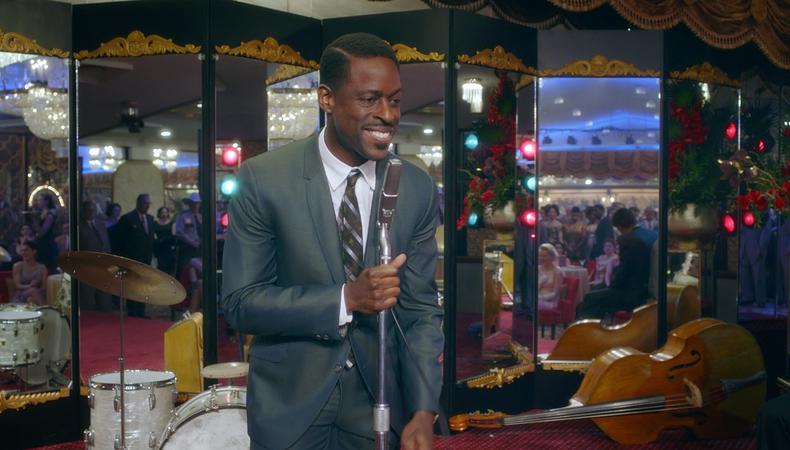
On a show like Amazon’s “The Marvelous Mrs. Maisel,” every day on set is a maelstrom of activity. Amidst the chaos, the production sound mixer has to manage and mobilize their team to capture high-quality audio recordings and honor the actors’ performances. On “Maisel,” this task falls to Mathew Price. 

Speaking to Backstage, Price shares why he calls the Amazon series a “a 1950s technicolor movie-musical screwball drama,” how the crew has become a large family, and the importance of knowing when to pick your battles and when to let things go in the interest of creative harmony.  

What does a production sound mixer do? 
It's my job to ensure that the quality of the recordings of the vocal performances are clean, clear, and reflect the acting that takes place while we’re filming. I always work on set while the cameras are rolling and the actors are acting. I'm also the head of a three-person department, which includes the boom operator as well as the sound utility [technician who] often acts as a second boom operator. 

How did you become a production sound mixer?
I always say there are two kinds of people: the “would-be frustrated musicians” and the “would-be high school fight nerds.” I’ve always been on the frustrated musician end of things. I love music. I thought maybe I'd work in recording studios with music and musicians, but I wound up becoming a film major [and] after school, worked for a video production company where I learned all about sound recording. 

From there I went freelance and did a lot of documentary work before I met a cameraman who invited me to a party where I met a sound mixer who asked me to be a boom operator for him. It was a four-week job, there was no money, but I was young and hungry, so I grabbed that opportunity. His name was Lee Orloff, and he just got a [Cinema Audio Society Filmmaker Award]. So somehow I hooked up with the best, which was an amazing learning experience. While I was working with him, I got the bug to mix on my own for narrative work as opposed to documentary work. The thing about documentary work was you meet so many amazing people and real stories are fascinating but the technology is a little limited and I wanted to do more. 

So I wound up mixing a few short films. I borrowed some equipment and I put my name out there. I was willing to work for [free] and the whole point of it was to get more experienced and to meet more people because I knew as a freelancer, it was really about who you knew.

What does a day in your life look like on “Mrs. Maisel”?
When we first come in at the beginning of the day—often 7 a.m. Monday—the first thing to do is set up the cart and check our batteries. While we set up, [they] do a blocking rehearsal where the director, script person, [and] actors work out the shot. They’ll do that in private and then they come out and invite the whole crew. 

A lot of the beginning of the day is just prepping for when we actually roll. My utility [technician] will hand out headphones to the director, a script person, producers, camera operators, and we get our boom mics put up. When it all comes together like a symphony, we get ready to rehearse. 

I try to keep my cart quite close to the set, but I don’t want to have to be on top of it because everything is radio mic for the most part. I usually set my sound cart up near the video monitors because I like to take a feed from the video people so I can watch on my monitor—I need to see exactly what the shots are. There’s an area called video village, which tends to be where the directors, producers, and script people are [so] they can watch on the monitors. A lot of times I’ll have to run onto the set if I need to make an adjustment on a radio mic on an actor. So I like to be nearby. 

My job is pretty much done at the end of the day when I get my track over to our camera people. I’m not the dialogue editor, though I have sat in on sessions where I’m able to hear my actual raw production dialogue tracks while they go through it and decide if they need to do any looping, any [Additional Dialogue Recording], or if they want to drop in music or sound effects.

Every show has its own style and presents its own challenges. But for me as a sound mixer the basis of it all [is the] actors. [They’re] talking in spaces and I need to record them as best as I can. That is the through-line. We [are] actually recording performances. Performances usually make a theme. The camera's great and it's beautiful and everything they do to make pretty pictures, but without the emotional content as a vocal performance, I don't feel like you have a theme. Our primary goal is to capture a really rich vocal performance. 

The joy of “Maisel” is that it's so carefully thought out, brilliantly choreographed. We have time to do it right. Every episode is like selling a major motion picture. I call, “Maisel” a 1950s technicolor movie-musical screwball drama. And for season three, we really upped our game because we're doing the music live, which presents a whole world of challenges. But Amy Sherman-Palladino is a real stickler for wanting the sound of the space that we're filming. So, they weren't actually playing live while we were filming, but [we filmed] the recording of them within the same space and Amy feels that it really matches when it really matches the space. It makes it feel real as opposed to what most people do, where they take a group into a studio and those studio recordings become the basis for your playback as opposed to doing it in the actual location that you're filming it.

How do you hire your crew?
I try to be very loyal to the people I work with, but it doesn’t always work out. First, I look [for] people [who] know what they’re doing. Especially for a show like “Maisel,” which is such a big show and present[s] so many wonderful challenges for the sound department, we really need a top-level crew. [It’s] really critical that I have a very good boom operator because the boom operator is not only just putting a mic over the actors, but they have to watch out for the frame line of the camera, make sure that the mic doesn’t get into the shot, look for shadows on walls that might be seen. I like the collaborative process, so there have to be good people who know how to communicate and treat other people well.

What advice do you have for an aspiring sound mixer?
I wish [I’d known] the politics of being a sound person on set because the sound department is dependent on every other department. We need wardrobe to help with wiring. We need electric for power. We need the grips to help put up the flags and help us with shadows on walls. We certainly need to work well with the camera department. And a lot of times, sound is given short shrift on a set because everyone's rushing to get the shot and sound has been called the bastard stepchild of the world. I wish I had learned politics better earlier on in my career. How to ask [for] what it is you need in a way that will most effectively get it for you. But also knowing when to ask, knowing which battles to pick, knowing when to let things go, and knowing when to fight for clean tracks. And that only comes with experience. 

For more on how to get work on a film crew, visit Backstage’s crew hub!

Author Headshot
Allie White

Allie is Backstage’s director of editorial operations, whose professional background includes women’s interest, news, health, beauty, and, of course, entertainment. Despite a crippling fear of singing in public, she still believes she’ll be a Broadway star one day.

See full bio and articles here!

Let's block ads! (Why?)


"sound" - Google News
June 29, 2020 at 09:34PM
https://ift.tt/2BeiREm

A Day in the Life of a Production Sound Mixer: Matthew Price of 'The Marvelous Mrs. Maisel' - Backstage
"sound" - Google News
https://ift.tt/2MmdHZm
Shoes Man Tutorial
Pos News Update
Meme Update
Korean Entertainment News
Japan News Update

Democrats add four candidates to 'Red to Blue' program - Roll Call

suaralifestyle.blogspot.com

Balter is the apparent winner of last week's Democratic primary in the 24th District to take on GOP Rep. John Katko, who is one of three Republicans running for reelection in districts Hillary Clinton won in 2016. The Associated Press has yet to call the race, but Balter led Navy veteran Francis Conole in initial returns, with 65 percent of the vote to Conole's 36 percent. Conole conceded to Balter on Thursday.

Balter lost to Katko by 5 percentage points in 2018 after battling against the DCCC's preferred candidate to win the primary. In 2016, Clinton won the 24th District, which includes Syracuse, by 4 points. Inside Elections with Nathan L. Gonzales rates the race Lean Republican.

Michelle De La Isla, Kansas

De La Isla is the first Latina elected mayor of Topeka in Kansas' 2nd District, which the DCCC added to its target list in January. President Donald Trump carried the district by 18 points in 2016, but Democrats believe they have an opportunity to unseat GOP Rep. Steve Watkins, who is under investigation for allegedly illegally voting in a Topeka election.

De La Isla does have competition from fellow Democrat James K. Windholz in the Aug. 4 primary. Windholz does not appear to have raised enough funds to require filing campaign finance reports to the Federal Election Commission.

As of March 31, De La Isla had raised $378,000 and her campaign had $267,000 on hand. Inside Elections rates the race Solid Republican.

Let's block ads! (Why?)


"four" - Google News
June 29, 2020 at 09:02PM
https://ift.tt/38drFX1

Democrats add four candidates to 'Red to Blue' program - Roll Call
"four" - Google News
https://ift.tt/2ZSDCx7
https://ift.tt/3fdGID3

Four things to watch out for in Serie A - Yahoo Sports

suaralifestyle.blogspot.com
Simone Inzaghi's Lazio have had a bitty restart to the season so far (AFP Photo/Alberto PIZZOLI)

Milan (AFP) - Juventus and Lazio continue their race for the Serie A title on Tuesday as the matches start to come thick and fast amid rising summer temperatures in Italy.

AFP looks at some of the key things to look out for in the midweek round of action.

Lazio try to peg back Juve

Lazio will have the chance to put pressure on title rivals Juventus on Tuesday when they travel to Torino looking to close the four-point gap between themselves and the reigning champions, who take on struggling Genoa.

Missing influential midfielder Lucas Leiva, Simone Inzaghi's side have got off to a slow restart but are still on Juve's tails thanks to their come-from-behind 2-1 win over Fiorentina on Saturday.

Juve have hardly ever looked convincing in Maurizio Sarri's first season in charge but are still favourites for a ninth league title thanks to an ability from their array of stars to dig out important goals when it counts.

Atalanta and Napoli prepare to dazzle

Free-wheeling Atalanta have carried on where they left off since the Serie A restart, crashing in and conceding goals by the bucketload as they strengthen their grip on the final Champions League spot.

Sunday's 3-2 win at Udinese was the second time in a matter or days that they had won by that margin and took their league goals tally to 80, with Josip Ilicic, Duvan Zapata and Luis Muriel -- scorer of two stunners in Udine -- sharing 44 of them almost equally.

Gian Piero Gasperini's fourth-placed side have won nine of their last 10 matches in all competitions scoring an average of nearly four goals per game, and are nine points clear of Roma in fifth after their limp 2-0 defeat at AC Milan.

On Thursday they host sixth-placed Napoli, another team looking good following their 3-1 win over SPAL on Sunday -- their fifth league win in a row.

Gennaro Gattuso's side may be 12 points behind Atalanta but the former AC Milan and Italy midfielder looks a solid fit in southern Italy. Triumph in the Italian Cup -- Gattuso's first major honour as a coach -- came after mature performances over both Inter Milan and Juventus.

Two league wins in two have fans hoping for Europe next season and a good showing in August's 'final eight' Champions League tournament in Lisbon.

Rebic pushing Milan towards Europe

Zlatan Ibrahimovic has often stolen the headlines since his return to AC Milan but if the long-ailing club return to Europe this club it could be thanks to another forward -- Ante Rebic.

The Croatian international, on loan from Eintracht Frankfurt, opened the scoring in Milan's 2-0 win over Roma and has scored nine times in his last 12 appearances in all competitions.

Stefano Pioli's outfit are just three points behind Napoli, who hold the last Europa League spot, ahead of Wednesday's trip to SPAL.

Samp's season in the balance

With SPAL and Brescia realistically already down to Serie B, four teams are battling to avoid the third and final spot in the relegation zone.

Still without injured striker Fabio Quagliarella, Sampdoria travel to Lecce on Wednesday hoping to put daylight between themselves and the bottom three after narrowly losing both their matches in June.

Claudio Ranieri's side are fourth-from-bottom, level on 26 points with local rivals Genoa and just a point above promoted Lecce, who are on a run of four straight defeats and conceded four times in both their recent losses to AC Milan and Juventus.

On Sunday Ranieri said that "Sampdoria's whole season is riding on" their cross-country trip to Puglia and the following home clash with SPAL four days later.

With Genoa hosting Juve and Udinese, who are on 28 points and have not won since mid-January, travelling to Roma, Wednesday's match is a great opportunity for both teams to boost their survival hopes.

Fixtures (all times GMT)

Tuesday

Torino v Lazio (1730), Genoa v Juventus (1945)

Wednesday

Bologna v Cagliari, Inter Milan v Brescia (both 1730), Fiorentina v Sassuolo, Hellas Verona v Parma, Lecce v Sampdoria, SPAL v AC Milan (all 1945)

Thursday

Atalanta v Napoli (1730), Roma v Udinese (1945)

Let's block ads! (Why?)


"four" - Google News
June 29, 2020 at 09:31PM
https://ift.tt/2NEsS03

Four things to watch out for in Serie A - Yahoo Sports
"four" - Google News
https://ift.tt/2ZSDCx7
https://ift.tt/3fdGID3

Artlist raises $48M led by KKR for its royalty-free music, video and sound effect library - TechCrunch

Like it or loathe it, video has proven to be the most engaging of all mediums across the web, and today a company out of Israel called Artlist — which provides royalty-free libraries of music, sound effects and even video itself to enhance video content — is announcing a significant growth round of $48 million, both to continue its expansion, and to build better technology to help navigate users to the perfect clip.

The funding is being led by KKR, with participation also from Elephant Partners, a VC out of Boston that has also backed Allbirds, Scopely and Keelvar among others. This is the first funding that Artlist has ever announced, although Elephant had backed it with a previously undisclosed amount previously. Ira Belsky, Artlist’s co-CEO who co-founded the company with Itzik Elbaz, and Eyal Raz and started as a filmmaker himself, said the company has mostly been bootstrapped since being founded in 2016. It’s not disclosing the total amount raised to date, nor its valuation except to say that it’s on the rise.

“We have been 100% cash flow positive since the day we started,” he said. “We just want to accelerate growth because there is an opportunity to cater to a wider audience.”

The market gap that Artlist is tackling is a byproduct of how the internet is used and evolving. According to a recent report from Sandvine, video accounts for just under 58% of online traffic globally, with video, social and gaming (with the latter two also being very video-heavy) together accounting for some 80% of traffic. That speaks to a huge amount of content being made available not just from premium media provides like Netflix or Disney, but popular a vast array of user-generated content on channels like YouTube, TikTok, Facebook and Twitter.

While some of these may be building their own sound and video content, a large part of those, to speed up production and focus on whatever aspect of their work that they can better individualise and control, many creators turn to stock audio and video footage in their work.

Indeed, there are a number of others in this same space, including the likes of Getty, Epidemic Sound, Shutterstock, Artgrid, the platforms themselves and many others, but Belsky said that in his time as a filmmaker, he found that many of these were not quite what he was looking for himself in terms of connecting him with just the right music that he was looking for, which was part of the impetus behind building Artlist.

What’s interesting is that Covid-19 has had a double impact on that market. Not only has there been a huge boost in online video usage as more people are spending time at home and staying away from public places, but in terms of creators, Belsky notes that many of them have found it harder either to shoot certain kinds of footage, or collaborate with people create music and other sound effects, all of which has led to a surge of usage for platforms like Artlist.

Artlist’s royalty-free model means that people pay subscription fees to Artlist to use its platform — prices range between $149 and $599 per year, depending on usage and whether you are taking the music, video, sound effects or combined plans — but then nothing more for individual clips. On the other side of the marketplace, the company does not disclose how much its artists are making from the service, but the basic model is that it varies depending on how much a track is used, and generally they are very competitive. “Our artists make more from us than they do from other platforms,” Belsky said. There are no plans to switch that business model include non-royalty-free, nor outright sales of exclusive rights, he added.
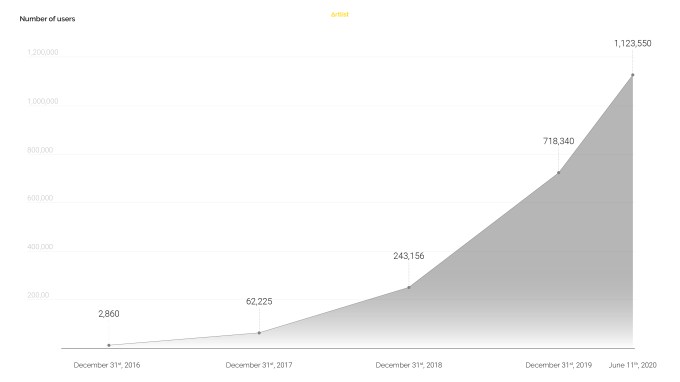
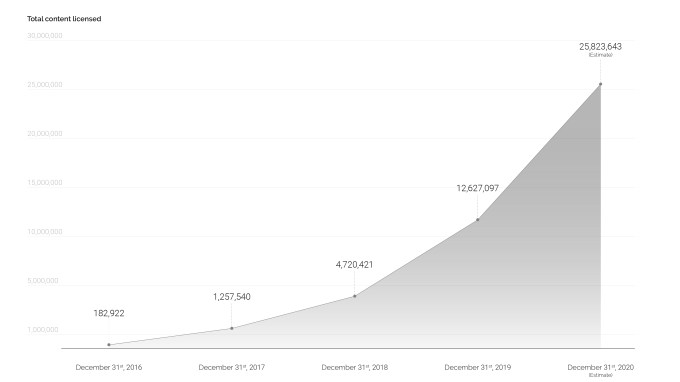
On royalty-free alone, the funding comes on the back of significant growth for the company in the last couple of years, with both users and amount of content both on exponential growth curves, respectively now standing at 1.1 million subscribers and 25.8 million pieces of content (mostly music at the moment, Belsky said).

While many users will incorporate one kind of media, either video or music, into a bigger video project — such as this Mercedes Benz commercial that uses Artlist audio — others looking to see how creative they can be when leaning on both, which speaks to how we might see video continue to evolve as the market matures and yet more video content gets produced:

That brings us to the company’s next steps. Belsky said that while today there are already various taxonomies for searching for just the right piece of content, the plan is to try to make that process more intuitive. Being based in Israel, the company has been tapping some interesting data science talent, and the country is well-known for producing some of the more interesting startups using AI and all of that is feeding into Artlist’s development, too.

“We want to invest in AI for personalisation,” he said. “We see ourselves in the creative tech space, a combination of content and technology. The aim is to find the best piece of music, but also the best user experience when finding it, to make it fast and intuitive.”

One experiment has involved people uploading examples of what they’d like, and Artlist searching for “matches” in its own catalogue, and there are others to come, he said. (Indeed, given what we’ve seen with the advances in semantic search, there is a potentially very interesting opportunity to start to explore how to, for example, ingest a video clip to try to match the mood of a piece of audio to it, which is not something that the company is exploring today, but could be an avenue down the line.)

Meanwhile, given Artlist’s traction and revenue growth, the opportunities and the needs of creators today are interesting enough to make this an interesting bet, despite the stiff competition.

“The growth of digital content creation – and the evolving way in which it is consumed – has generated a tremendous amount of opportunities for creators, but the process of licensing digital assets remains a significant challenge for small and large creators alike,” said Patrick Devine, a member of KKR’s Next Generation Technology Growth investment team, in a statement. “What impresses us most about Artlist is the management team’s dedication to helping creators focus on what they do best and removing friction from the process of discovering and accessing content.”

Let's block ads! (Why?)


"sound" - Google News
June 29, 2020 at 06:16PM
https://ift.tt/3g7Z6Nh

Artlist raises $48M led by KKR for its royalty-free music, video and sound effect library - TechCrunch
"sound" - Google News
https://ift.tt/2MmdHZm
Shoes Man Tutorial
Pos News Update
Meme Update
Korean Entertainment News
Japan News Update

The Sound of No Music (letter to the editor) - SILive.com

That sound that Staten Islanders are not hearing this June is that of the Sing For Hope street pianos. The pianos are a great combination of music and art and appear for three weeks each year, late spring into early summer. Every person can sit and play.

Each piano has a different subject matter (fish, flowers, Jackie Kennedy, Broadway, etc.) Each piano is painted by a different artist. Several have had Staten Island themes.

Six pianos have popped up on Staten Island during each of the past several years. Some of the locations include Snug Harbor Cultural Center, Historic Richmond own, Clove Lakes Park, Greenbelt Nature Center, Kivlehan Park, Piece A Cake, the St. George Ferry Terminal, Conference House Park and the Midland Beach Boardwalk.

Some have a piano every year. Some have them less frequently. But it’s always a joy to meet Staten Islanders who are playing the pianos, as well as folks who are standing around and enjoying listening to the music. It also is great talking to people who work at the various locations, who are kind enough to uncover a piano that may have been covered up due to threat of rain, just long enough for me to get a photo.

It’s always a challenge to see how many of the pianos one can get to in a day. Having no car, I use the MTA buses and the Staten Island Railway, a bit of an “adventure” to be sure (and lots of subway lines in the other four boroughs).

There used to be 88 pianos on display each year during the event. That has been cut to approximately 50. It is quite a trek getting out to remote parts of the Bronx and Queens. I came within one piano of seeing them all on display two years ago.

Last year I only made it to 40, as rain and the threat of rain caused the pianos to be closed for six or seven days.

After the three weeks, the pianos are donated to NYC schools. I was pleasantly surprised to see one in the auditorium of my old alma mater, Curtis High School, when I was there last December.

So why no street pianos this year? COVID-19 claims yet another cultural event.

Hopefully the street pianos will pop up again on Staten Island and throughout NYC next year. In the meantime, practice your piano and start thinking up unique designs and themes for the 2021 Sing for Hope event. You can get all of the info you need at www.singforhope.org

(Richard Richman is a Sunnyside resident.)

Let's block ads! (Why?)


"sound" - Google News
June 29, 2020 at 06:18PM
https://ift.tt/3eJWk0C

The Sound of No Music (letter to the editor) - SILive.com
"sound" - Google News
https://ift.tt/2MmdHZm
Shoes Man Tutorial
Pos News Update
Meme Update
Korean Entertainment News
Japan News Update

Are you of sound mind? | Comment | ekathimerini.com - www.ekathimerini.com

The Covid-19 pandemic brought out the best and the worst in people. Among the best was that in the USA nurses and doctors volunteered to go to New York City and help, while risking their lives; meanwhile in Greece the vast majority of people obeyed directives to stay indoors and as a result the country experienced among the lowest levels of contamination and deaths in the world.

And the worst: conspiracy theories. I generally find such theories amusing and have been following them on the internet for years. Some are totally harmless: “Elvis is alive and living in Michigan!” Others try to cause mischief but fail: “Obama cannot become US president because he was born in Kenya.” But when it comes to issues of health, such theories can cause major problems.

It was a few years ago that I first heard of some parents claiming that vaccination caused their children to develop autism. It turns out the study that “discovered” that connection was anything but impartial, and that lawyers who made money by suing medical companies financed the UK study in question. Nevertheless, the story would not die. Thousands of medical doctors opined that there is no connection between autism and vaccination.

Unfortunately, the “other side” had as its spokesperson a well-known actress whose son, she claims, contracted autism after vaccination. As a parent, I understand her agony of dealing with her son’s health, but that does not make her opinion valid. The media did not help. I remember that when a medical study proved there was no vaccine/autism connection, one of the popular morning shows in the US asked the actress in question for her opinion. On one side a well-conducted scientific study, and on the other a Hollywood actress. And still, some people doubted the science.

It appears that Greece is also fertile ground for such conspiracies: “Covid is caused by the 5G internet network!” “Bill Gates wants us all to get vaccinated so he can control us more easily.” To my fellow Americans and Greeks who believe such theories, I ask a simple question: “Are you of sound mind?” Why believe in such nonsense? I have had the same doctor for 29 years. He tells me vaccination is OK. Is he lying? Is he a paid agent of Bill Gates? George Soros? Are thousands, even millions of doctors all over the world agents of malevolent billionaires? Do they want us all to die?

Here’s another question: If my doctor lies to me about vaccines in general and Covid-19 in particular, why should I listen to him when he tells me to take a particular drug for high blood pressure? Should I believe him when he says I need an operation to remove a tumor? If he is paid by “them” to kill me through medicine, why stop at vaccines? Why not prescribe the wrong medicine? Those who claim that doctors are paid by dark forces should stay away from all medical advice and procedures for ever. They will still be wrong but at least they will be consistent. As for me, I will continue following my doctor’s advice. Since I started doing so 29 years ago I feel as good as any middle-aged man (who likes his wine and red meat) can feel!


John A. Mazis is a history professor at Hamline University in Saint Paul, Minnesota.

Let's block ads! (Why?)


"sound" - Google News
June 29, 2020 at 03:29PM
https://ift.tt/2Vsh19v

Are you of sound mind? | Comment | ekathimerini.com - www.ekathimerini.com
"sound" - Google News
https://ift.tt/2MmdHZm
Shoes Man Tutorial
Pos News Update
Meme Update
Korean Entertainment News
Japan News Update

Search

Featured Post

Mysterious noise irking Tampa residents may be fish mating loudly: 'Pretty uncommon phenomenon' - New York Post

Residents of Tampa, Florida have reported hearing strange noises coming from the bay for years, and now scientists believe it may be fish ...

Postingan Populer