A PREDICTOR OF STROKE
As COVID-19 engulfed parts of the country last spring, doctors at Emory braced for a wave of infections they knew would soon be heading their way. Fairly early on, a link emerged between the virus and blood clots that can cause stroke, an interruption of the blood supply to the brain.
That was particularly worrisome to Fadi Nahab, MD, stroke quality director for Emory Healthcare and an associate professor of neurology in the Emory School of Medicine. Georgia is in what is often referred to as the “stroke belt” — a swath of southern states where age-adjusted stroke mortality rates are already high. What would the death toll look like if COVID-19 boosted those numbers even higher?
A multi-specialty group of Emory doctors had been meeting to determine the best practices for treatment and to also see where there were gaps in research they could help fill.
One of the gaps they identified: Is there a way to predict who might have a clotting disorder that would lead to stroke and then head it off?
Nahab and others began tracking patients hospitalized with stroke, heart attack, deep vein thrombosis and other vascular problems to see if there was a common signature — or biomarker — in their blood.
The Emory team identified a biomarker that was able to accurately identify patients at higher risk of clotting disorders that could lead to stroke. Those patients underwent an aggressive regimen of blood thinners and other drugs.
The result: “We appear to have lower mortality rates from COVID than other published COVID cohorts around the world,” Nahab said.
What’s particularly striking are racial differences.
“We knew that a high rate of the nonwhite population was getting COVID,” Nahab said.
And a higher number of African Americans were arriving at hospitals with additional health problems like high blood pressure, diabetes and obesity.
But the treatment seemed to help to address that disparity.
“What we found is that patients of color were having as good of outcomes as white patients admitted to our Emory hospitals despite those patients having more co-morbidities that could place them at a higher of risk of having complications,” Nahab said.
More work and research is needed, but early reaction to the group’s findings have been encouraging.
“Many other hospital systems have called and adopted our guidelines, understanding that they were still evolving,” Nahab said.
“SYMPATHETIC STORM”
In April, Emory neurologist Karima Benameur was in the middle of a grueling seven-week stretch of clinical duties. She’d spent a blur of days and nights at Emory University Hospital and EUH Midtown examining patients with severe COVID-19 infection to see if they had neurological complications.
That was when she and the nurses on shift noticed it: Some of the COVID patients were experiencing recurring cycles of racing heartbeats, rapid breathing, hypertension and agitation.
It reminded Benameur of a phenomenon called “sympathetic storm,” usually described in connection with physical head trauma. Was the virus to blame for the “storming?” And, if so, what did that mean?
Researchers have been uncertain whether the neurological effects of COVID-19 come from blood clots and strokes, or from inflammation and infectious damage of brain tissue itself. Benameur enlisted her colleague William Hu, whose lab has developed sensitive tests for antiviral antibodies, to see if they could try to help answer that question.
In some patients with impaired reflexes, they’ve been able to detect antiviral antibodies in cerebrospinal fluid, a sign that infection had reached the central nervous system. The work is in its early stages but could point to changes in critical care.
While sympathetic storm may sound alarming, it actually suggests a gentler way to treat patients. Such symptoms are often perceived as delirium, and patients are given sedatives or anesthetics such as ketamine.
Instead, in this situation, physicians could choose alternative medications that target the sympathetic nervous system, such as beta-blockers or bromocriptine. Choosing different medications could reduce long stays in the ICU and mitigate the risks of long term neurological damage, Benameur said.
MENTAL HEALTH IMPACTS
In the throes of the pandemic, Nadine Kaslow, PhD, has been helping the Emory community keep its balance. Kaslow, PhD, professor and vice chair for faculty development, diversity, equity and inclusion in Emory’s Department of Psychiatry and Behavioral Sciences, has urged health care workers and others to keep their mental equilibrium by making time to do the things they love.
For Kaslow, that’s ballet. So one July afternoon she tried to practice what she preached, slipping into a leotard for an online dance workout in her office on the campus of Grady Hospital. One particularly strong arabesque later and she’d toppled a shelf of books. Almost immediately her phone began buzzing.
“I’m on the phone handling a crisis. And the person on the other end says, ‘What’s that noise?’” Kaslow recalls with a laugh. “‘Well that’s my ballet teacher.’”
“Imagine if someone walked in. I’m in leotard and tights in my office, music going, handling a crisis and kicking books. That is unheard of,” Kaslow said. “But it captures where we are right now.”
Kaslow and others in Emory’s Department of Psychiatry and Behavioral Sciences were hard at work as the first COVID-19 infections were hitting Georgia. Working with colleagues from other departments in the school of medicine, they quickly launched a support network, Caring Communities, to provide help to frontline health care workers.
SEE “CARING FOR THE CAREGIVERS” BELOW
They’ve also been helping patients with COVID-19 and their families, as well as the larger community, cope with the strange new world of masks, social distancing, job loss, fear of infection, Zoom funerals and job loss.
Kaslow and colleagues have been invited to provide guidance about optimizing mental health during the pandemic to colleagues in nations throughout Africa, as well as in other countries such as Saudi Arabia. Their work is being used as model by the World Health Organization in Africa and the U.S. Department of State.
“The disruption of our normal rhythms is terribly anxiety provoking,” said Mark Rapaport, chair of Emory’s Department of Psychiatry. “The lack of true interaction, the lack of being able to reach out and touch people you care about and you love.”
Already there are disturbing signs. Reports of domestic violence and child abuse are on the rise. So are alcohol sales. After experiencing a slight pre-pandemic decline, opioid overdose deaths are once again rising across the country.
“The pandemic has increased risk factors like stress, anxiety, depression, housing and financial instability,” said Justine Welsh, MD, director of Emory Healthcare Addiction Services. “These are all risk factors for substance use.”
It’s also chipped away at so-called protective factors, like social connections.
“And for many people their recovery system is built upon an infrastructure of social supports,” she said.
In addition to seeing patients, Emory’s mental health caregivers are hoping to learn from the pandemic. One grant from the Woodruff Health Sciences Center will focus on studying intimate partner violence and suicide throughout the state of Georgia.
Another, funded by the Emory-Georgia Tech Healthcare Innovation Program, will look at COVID-19 experiences through interviews and social media analysis of frontline health care workers, including first responders.
Census data being collected weekly shows anxiety and depression are soaring to new levels. Among patients who have had COVID-19, research is suggesting the cause could be neurological.
“There may be real brain issues that are causing the depression,” said Milton, the physiatrist. “In other words, real issues in the emotional centers of the brain that actually are impacted.”
“This may not be just an emotional problem but really a disease process problem that’s casing the depression and anxiety.”
Kaslow said if there is one silver lining to take from the pandemic, it is that mental health issues seem to have lost some of their stigma.
“But I am not convinced that there are more services available. So, while more people feel like they can acknowledge it, I don’t think that there are more services for them to access,” she said.
And she worries about the long term impacts, especially on kids.
“Are we creating a generation of obsessive hand washers who haven’t learned how to socialize?” she asked.
“There is a real sense of grief right now,” Kaslow added. “Part of the grieving process is giving someone a hug.”
But with social distancing hugs have become largely forbidden.
“What is the long-term effect of not getting – and giving – hugs?” she asked.
‘I MADE IT THROUGH’
Elizabeth Matthews spent six days at Emory St. Joseph’s Hospital battling COVID-19 and recovering from a stroke.
She arrived home and was told to quarantine for 14 days, although she did 17 days for good measure.
Matthews doesn’t know whether COVID-19 contributed to her stroke. Retired as a factory worker at the now defunct General Motors plant in Doraville, she’s taking it easy these days. Her breathing can still be labored; she gets winded easily.
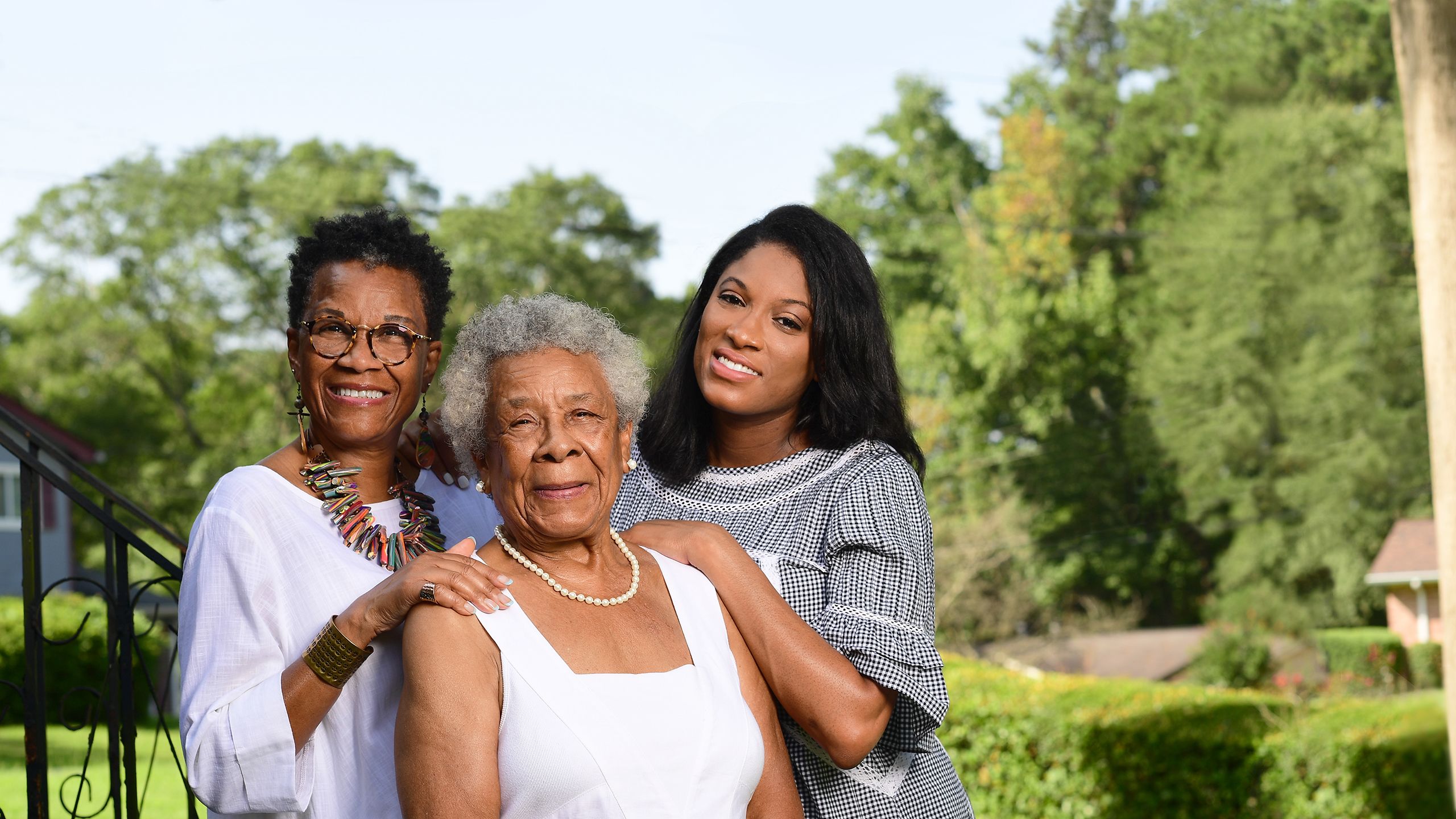
The three generations of women in this family are close. Really close.
“If we were any closer, it would be weird,” jokes Mikisha Johnson.
They miss their T.J. Maxx shopping trips together. But they’re also grateful that Elizabeth Matthews will be around when her granddaughter has her first baby, due at the end of September.
“I thank the Lord I made it through,” Matthews said.
"sound" - Google News
September 10, 2020 at 01:01AM
https://ift.tt/2GMduyz
"Grandmama doesn't sound right": COVID-19 and the brain - Emory News Center
"sound" - Google News
https://ift.tt/2MmdHZm
Shoes Man Tutorial
Pos News Update
Meme Update
Korean Entertainment News
Japan News Update


No comments:
Post a Comment