PALMDALE — Someday, travelers will be able to cross the country in flights that take a fraction of the time as today’s airliners, as commercial aircraft traveling faster than the speed of sound come into use.
Before those cross-country flights are possible, however, NASA is studying how they may fly over populated areas without the startling sonic booms that result.
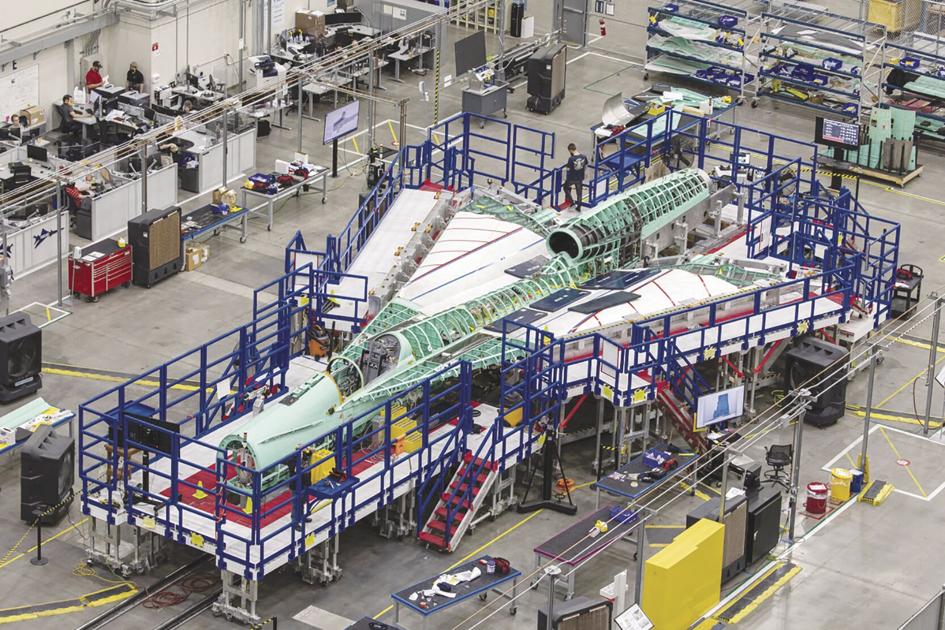
The X-59 Quiet Supersonic Technology demonstrator aircraft is a one-off, experimental research plane to demonstrate the technologies to allow aircraft to travel beyond the speed of sound, without creating disruptive sonic booms for those on the ground below.
This is expected to pave the way for supersonic commercial passenger air travel over land — something prohibited today due to the effects of sonic booms.
The unique aircraft is under assembly at Lockheed Martin’s facility at Air Force Plant 42 in Palmdale. NASA awarded Lockheed Martin a $247.5 million contract for the demonstrator in April 2018.
The X-59 will eventually fly from NASA Armstrong Flight Research Center at Edwards Air Force Base.
“It really looks like an airplane now,” Low-Boom Flight Demonstration Deputy Program Manager Cathy Bahm said.
Assembly is on track to complete the manufacturing later this year, when the aircraft will be sent to Lockheed’s facility in Ft. Worth, Texas, for ground testing, including loads the aircraft structure would encounter in flight and tests of the fuel system, Bahm said.
It will return early next year for additional ground tests, before the first flight expected next summer.
At the same time the aircraft itself is being built, work is ongoing to prepare the many subsystems that will be needed, such as the life support equipment to protect the aircraft’s single pilot.
The team from Armstrong is working with contractor KBR on ensuring the life support and emergency oxygen systems will meet the unique needs of the X-59.
The equipment itself is not new, but how it is integrated and used in the X-59 is unique, Deputy Operations Lead Brian Griffin said.
“Because our mission is a bit different, we require a bit different in terms of performance and capability,” he said. “It’s using existing aircraft hardware but put together in a unique way.”
Recently, they have been testing the equipment at KBR’s facility in San Antonio, Texas, where there is a chamber that can simulate the reduced pressures at very high altitudes, where the X-59 will eventually fly.
These high altitudes — between 50,000 and 60,000 feet in altitude — make for some special needs for the cockpit life support systems.
Most airliners travel at around 30,000 feet altitude.
Standard equipment for military jets is typically designed for use up to 50,000 feet, so adaptions are made to meet the X-59’s 60,000-foot ceiling.
“We’re basically filling that gap,” Griffin said.
For example, the emergency ejection seat must carry more oxygen than in an aircraft traveling at lower altitudes
Most of the system testing is done, with the final step of testing on live subjects left to be completed.
“It’s been definitely a lot of fun to be a part of the project,” Griffin said. “To see it going from just drawings on a piece of paper, to actual hardware that’s in a hangar, to an airplane that’s sitting out on the ramp one day. It’s really, really cool.”
The initial handful of flights from Palmdale will confirm the aircraft is operating properly and there are no big issues, Bahm said.
It will then move to Armstrong for a series of envelope expansion flights, gradually proving out the aircraft’s performance and safety throughout the range of its capabilities.
The aircraft is intended to fly at 55,000 feet and at Mach 1.4, or about 1,075 mph.
Following those flights, the program will move into the research phase in the spring of 2023, first to validate its acoustic properties.
This will entail a series of flights in which other aircraft — either an F-15 or F-18 chase aircraft — will probe into the air beneath the X-59 to collect data on the shock waves as they form. These shock waves, if they coalesce, cause sonic booms.
Data will also be collected by a series of microphones arrayed on the ground.
All together, this data will create a picture of the shock waves created by the X-59, and will be used to validate prediction models, Bahm said.
The program will also use a special type of photography, called Schlieren imaging, to look at the shock waves coming off the supersonic airplane.
The next phase will be community overflights, to gauge people’s reactions to what researchers expect will be a small thump, if any sound at all, instead of the jarring sonic booms that people in the Antelope Valley are familiar with.
The initial community overflights will be based from Edwards, targeting communities that do not usually hear sonic booms, Bahm said.
A second phase will take the X-59 farther afield, deploying to other parts of the country to collect data. The goal is to collect data from various areas, to be representative of the flight paths future commercial supersonic airliners would take, she said.
"sound" - Google News
August 08, 2021 at 06:00PM
https://ift.tt/3ywlvNW
Breaking sound barrier quietly | News | avpress.com - Antelope Valley Press
"sound" - Google News
https://ift.tt/2MmdHZm
Shoes Man Tutorial
Pos News Update
Meme Update
Korean Entertainment News
Japan News Update


No comments:
Post a Comment